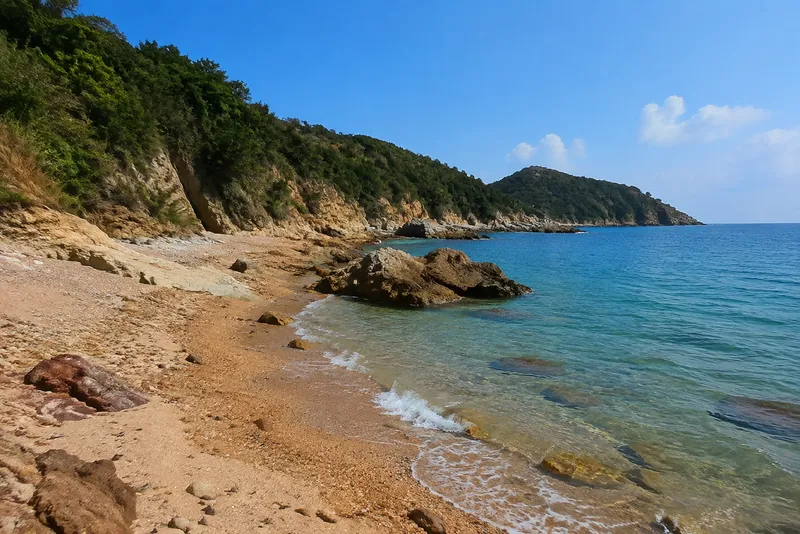
Shangdong Beach
上洞The verdict
Only for experienced, well-equipped outdoor people who value being truly alone more than safety margin. For everyone else, pick Shuitousha or Judiaosha instead.
Perfect for
- ✓ Experienced hikers and scramblers
- ✓ Sunrise photographers who don't mind a flashlight approach
- ✓ People with wilderness training who understand tide and weather
- ✓ Anyone who genuinely wants to be the only human on a beach
Not for
- ✗ Basically everyone else — families, casual swimmers, first-timers
- ✗ Anyone without sturdy shoes, water, first aid, and offline maps
- ✗ Visitors on a weather-limit day (no-shade, no-shelter)
- ✗ Anyone who needs signal or fast emergency access
Editor's field note · Verified February 2026
Visited once, with a local outdoor club, in good conditions: the approach genuinely needs scrambling, the sunrise is everything people say, and there was one other group in three hours. The beach is gorgeous and it is the highest-risk spot on this site — the two facts are not in tension.
Overview
Shangdong Beach (上洞) is the most remote and least visited beach on this guide — a wild, rugged stretch of coastline near the eastern edge of the Dapeng Peninsula. If Shuitousha is hidden, Shangdong is practically secret. There are no signs, no facilities, no parking lot, and no easy access. Finding it requires determination, and being there feels like discovering something that was not meant to be found.
The beach is about 400 meters of coarse sand and rock, backed by steep vegetated hills and facing the open South China Sea. The waves here are stronger than at the sheltered western beaches, the water is deep close to shore, and the overall atmosphere is raw and untamed. This is not a swimming beach — the currents are unpredictable, there are no lifeguards, and the rocky sections make entering the water hazardous. It is a beach for walking, exploring, photographing, and experiencing the wilder side of Shenzhen's coastline.
Shangdong's remoteness is its defining characteristic. The access involves a combination of driving narrow roads, walking unmarked paths, and a certain amount of scrambling over rocks. There is no phone signal in parts of the approach, and you are unlikely to encounter another person once you arrive. For experienced outdoor enthusiasts, photographers seeking untouched coastal landscapes, and anyone who values solitude above all else, Shangdong delivers an experience that feels impossibly far from a city of 17 million.
This beach is emphatically not for everyone. Families, casual swimmers, and anyone expecting facilities should stay far away. But for the right person — the adventurer, the solitude-seeker, the photographer chasing raw coastal scenery — Shangdong might be the most rewarding beach in Shenzhen.
How to Plan Your Day
A concrete plan for Shangdong, based on our visits. Start Only in good weather. Weekdays. Leave the city by 6:30 AM for sunrise; otherwise aim for 9 AM.
Half-day plan (4-5 hours)
- 1Drive via Dongchong village (15-20 min) — do not trust phone signal in the approach.
- 2Park informally roadside, then walk/offline-map the unmarked approach.
- 3Scramble to the eastern end for the open-sea sunrise or the wild-coast panorama.
- 4Pack out everything, including trash. Reverse the route before heat peaks in summer.
Full-day plan (7+ hours)
- 1Treat every hour as an expedition: offline maps, GPS, 3L+ water per person, full first-aid, tell someone your return time.
- 2Explore the coves and rock pools along the wild coastline.
- 3Photograph long-exposure waves at dusk if staying on a neighbouring beach, not here.
- 4Return to Dongchong or Xichong (25 min drive) for a proper meal.
Avoiding the crowds
There is no crowd — that's the product. What to avoid instead: typhoon season (Aug-Sep), rain, high tide at the access points, and summer midday heat with zero shade.
Money tip
It's the cheapest beach in Shenzhen because it costs you in risk, not money — transport plus 50-100 RMB of picnic supplies. Don't budget-trick yourself into under-preparing.
Plan Your Trip to Shangdong
Two quick tools built from our verified data — pack right and know what it'll cost before you go.
Packing Checklist
Tick as you pack — your progress is saved in this browser.
Day-Cost Estimator
Approximate total per person for one day.
How Shangdong Compares to Its Rivals
The beaches visitors most often weigh against Shangdong — and which one to pick in each situation.
The two 'empty' options across the difficulty spectrum.
Choose Shangdong when
You want wilderness-grade solitude, scrambling, and open-sea sunrise — and can handle the risk.
Choose Shuitousha when
You want a coastal walk you can finish in sandals, reachable from Nanao.
The nearest developed base with the same wild coastline.
Choose Shangdong when
Empty-ocean sunrise beats everything, even comfort.
Choose Dongchong when
You want bouldering-free access, seafood, and a trail to hike instead of an unmarked scramble.
How to Get to Shangdong Beach
- Bus
- Limited. Best by car or taxi. Nearest bus stop requires 20+ min walk.
- Taxi from Futian
- ~155 RMB (60 min)
- Taxi from Luohu
- ~115 RMB (50 min)
- Taxi from Nanshan
- ~175 RMB (70 min)
- Driving
- 50-60 min
- Parking
- Informal roadside. No designated lot.
Food & Dining
At the Beach
Nothing. There are no vendors, no shops, and no facilities of any kind within walking distance.
Nearby
The nearest food is in Dongchong village (15-20 min drive) or Nanao town (25 min drive). Both have restaurants ranging from simple noodle shops to seafood restaurants.
What to Try
Pack a substantial picnic. Bring more water than you think you need. After your visit, head to Dongchong village for a well-earned seafood dinner.
Price range: Self-catered: 50-100 RMB per person for picnic supplies. Dongchong restaurant meal: 80-150 RMB per person.
Where to Stay
The nearest accommodation is in Dongchong village (15-20 min drive), which has guesthouses and small hotels (150-350 RMB/night). Xichong (25 min drive) has more options including surf-themed guesthouses and camping.
Camping
Possible for experienced campers only. No facilities, no permitted zones, no support. Bring all gear, including water, and take everything back. No fires. Inform someone of your plans before going.
Price range: Nearby guesthouse (Dongchong/Xichong): 150-400 RMB/night.
What to Wear & Bring
Summer (May-Oct)
Full beach survival kit. Swimwear, sturdy shoes for rocks, full sun protection (zero shade), water shoes. Pack as if going into wilderness.
Winter (Nov-Apr)
Hiking gear more than beach gear. Dramatic scenery but dangerous for swimming.
Packing Checklist
- ✓ Everything. Seriously.
- ✓ Water (3L+ per person)
- ✓ Full meal/picnic
- ✓ Sunscreen + hat + UV protection
- ✓ Sturdy shoes (rocks are sharp)
- ✓ Comprehensive first aid kit
- ✓ Phone + power bank + offline maps
- ✓ Tell someone your plans
- ✓ Trash bags
- ✓ Toilet paper + hand sanitizer
Facilities
- Showers
- None
- Lockers
- None
- Umbrellas/Chairs
- None
- Lifeguards
- No
- Food/Drinks
- None
- Restrooms
- None
- Changing Rooms
- None
- First Aid
- None
Beach Features
- Sand Type
- Mixed sand and rock, ~200m
- Water Quality
- Grade I (untouched)
- Wave Type
- Varies, exposed coastline
- Best Season
- May-September
- Swimming Zone
- None
When to Avoid
Typhoon season (Aug-Sep) — the exposed coastline makes conditions extremely dangerous. Rainy days — the access path becomes slippery and hazardous. High tide — some access points are submerged. Summer midday — there is zero shade and heat stroke is a real risk.
Things to Do
Coastal Exploration
Walk the length of the beach and explore the rocky sections at both ends. The coastline here is dramatic and unspoiled — you may find small coves and rock pools that are not marked on any map.
Landscape Photography
The wild, undeveloped coastline offers rare photographic opportunities near Shenzhen. Dramatic skies, textured rocks, and the contrast between green hills and blue sea.
Solitude
You will almost certainly be the only person on the beach. No sounds except waves, wind, and birds. A profound sense of isolation that is vanishingly rare so close to a major city.
Sunrise Watching
Shangdong faces east, making it one of the best sunrise spots on the peninsula. Arrive before dawn, navigate by flashlight, and watch the sun rise over the open South China Sea.
Safety
Best Time to Visit
Shangdong Beach (上洞) offers ideal conditions during May-September.
Photo Spots
Sunrise over the open sea from the eastern end of the beach. The rugged rocky coastline with waves crashing against the rocks. Wide panoramas showing the untouched coastline and green hills behind. Long exposure shots of waves at dusk.
History & Background
Shangdong has no recorded history of development or settlement — it has always been a remote, undeveloped stretch of coastline. Its name means Upper Cave in Chinese, possibly referring to natural rock formations along the shore. The beach remains unknown to the vast majority of Shenzhen residents and visitors.
Visitor Tips
- • This beach is for experienced outdoor enthusiasts only — do not attempt without preparation
- • Bring a GPS or offline map — phone signal is unreliable in the approach area
- • Wear sturdy shoes — the access involves scrambling over rocks
- • Bring 2-3L of water per person and all food — there are no supplies anywhere nearby
- • Tell someone where you are going and when you expect to return
- • Check tide times — some access points are cut off at high tide